Our programs

Scientific learning as the basis for holistic development
Our programs

The Nido

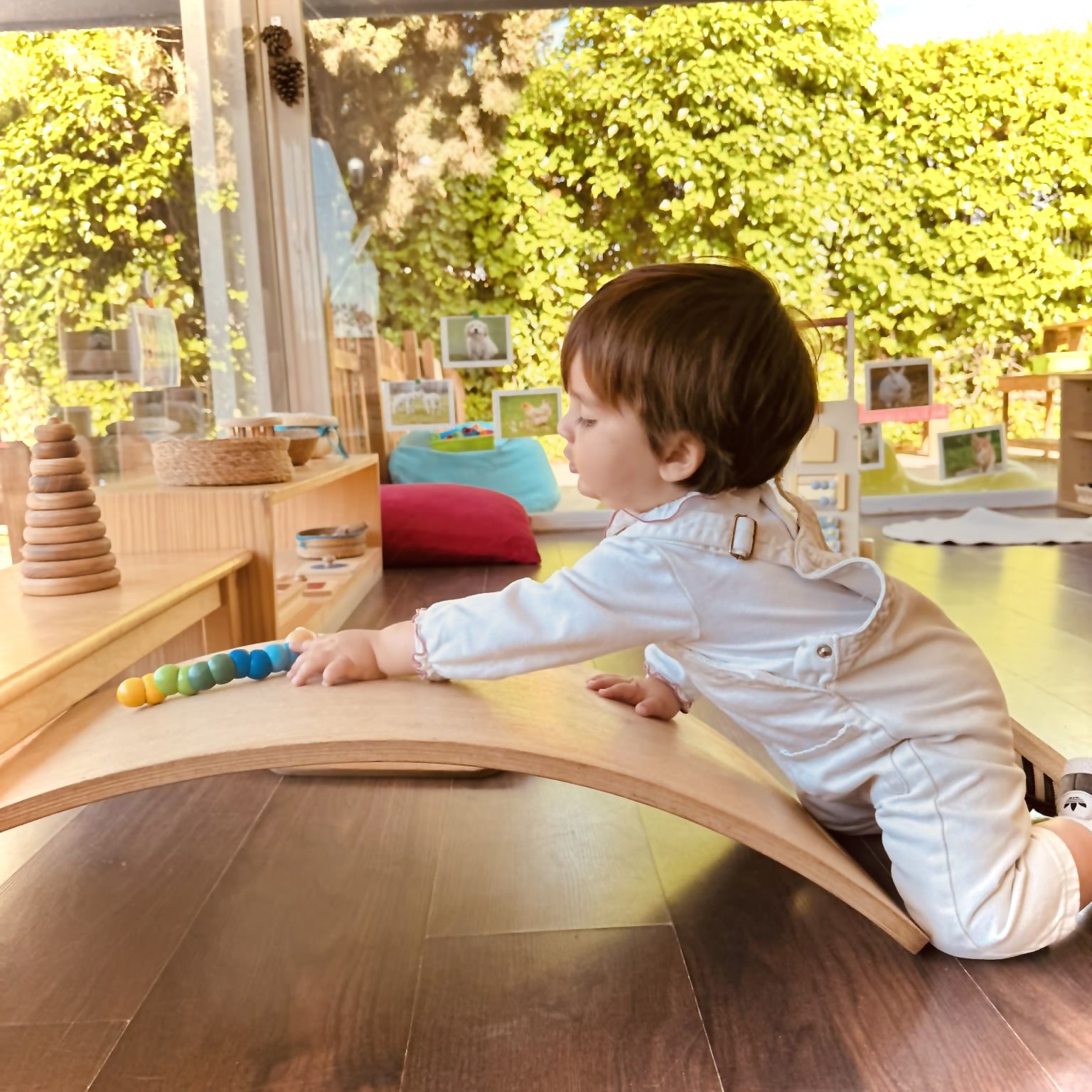
The Nido is a Montessori environment designed and structured especially for babies from 6 months to the moment they walk with some confidence. It is a space where peace and tranquillity reign and where the little ones can rest and explore safely with close attention and care. Families and their babies have a separate entrance and gardens from the older children to provide them with more calm, security and intimacy at the start and the end of the day.

In The Nido, there are a maximum of 4 babies per adult.

The atmosphere of Nido Montessori is a calm and homely place decorated with neutral colours and equipped with lots of beautiful and interesting materials. The space has direct access to a special outdoor area where babies can enjoy the sounds and proximity of nature. Babies are always treated with dignity and the utmost respect for their rhythms and needs.
Materials designed to capture the interest and curiosity of babies in their first year of life invite them to explore and learn about the world around them. Sensory exploration baskets contain a variety of textures, shapes, and colours. To develop their gross motor skills, they have supports and structures to practice with freedom of movement, which gives them opportunities to master their own movements and grow into young children with confidence and independence in their motor skills.
The teacher in our Nido environment is specialised in the development of young infants and babies. She ensures that each one feels cared for and respected so that they feel safe in their explorations. Our Montessori Teachers for 0–3-year-olds have been trained to observe each child's needs, sensitivities and interests and prepare the baby's environment to promote healthy and robust development. In addition, they are trained in baby anatomy and physiology, as well as nutrition for babies, child hygiene, health, and safety. They also have knowledge of neuropsychiatry, which supports them in guiding the development of the child's personality Our Nido Montessori guides are also Early Childhood Education Teachers and always speak with the babies in English.
The postpartum period can be a challenging time for new families as they navigate the responsibilities of parenthood and work. It is a particularly sensitive and vulnerable period in our adult development. At Montessori Córdoba, we are qualified and experienced in providing the necessary support and information to help families care for their baby's development at home. We organise various meetings and talks to share knowledge and ensure that life at home and school works in harmony, providing a predictable routine with the love, tranquillity, and security that human beings need in their first year of life.

The Infant Community

Our Infant Community is a carefully designed environment for children who have already begun to walk until they are around three years old. Autonomy, independence and respect are encouraged from an early age. Through practical and sensory activities, children explore and learn in a supportive and caring environment, laying the foundation for comprehensive and lasting development. Children have separate entrances and gardens from children aged 3 – 12 years to provide them with more security and intimacy during drop off and pick up.

In the Infant Community, there are a maximum of 7 children per adult.

When children reach the stage where they can walk, they benefit the most from being in our infant community.

During infancy, children are primarily motivated by exploring their senses and movements. To aid in this development, the materials and spaces in the Infant Community environment have been carefully designed to help them improve their gross (whole body) and fine (hands) motor skills, and to provide a diverse range of sensory experiences. They have access to objects with a variety of colours, materials, smells, flavours, and textures, ensuring that they are happily engaged and exploring their surroundings both inside the classroom and out in the garden.
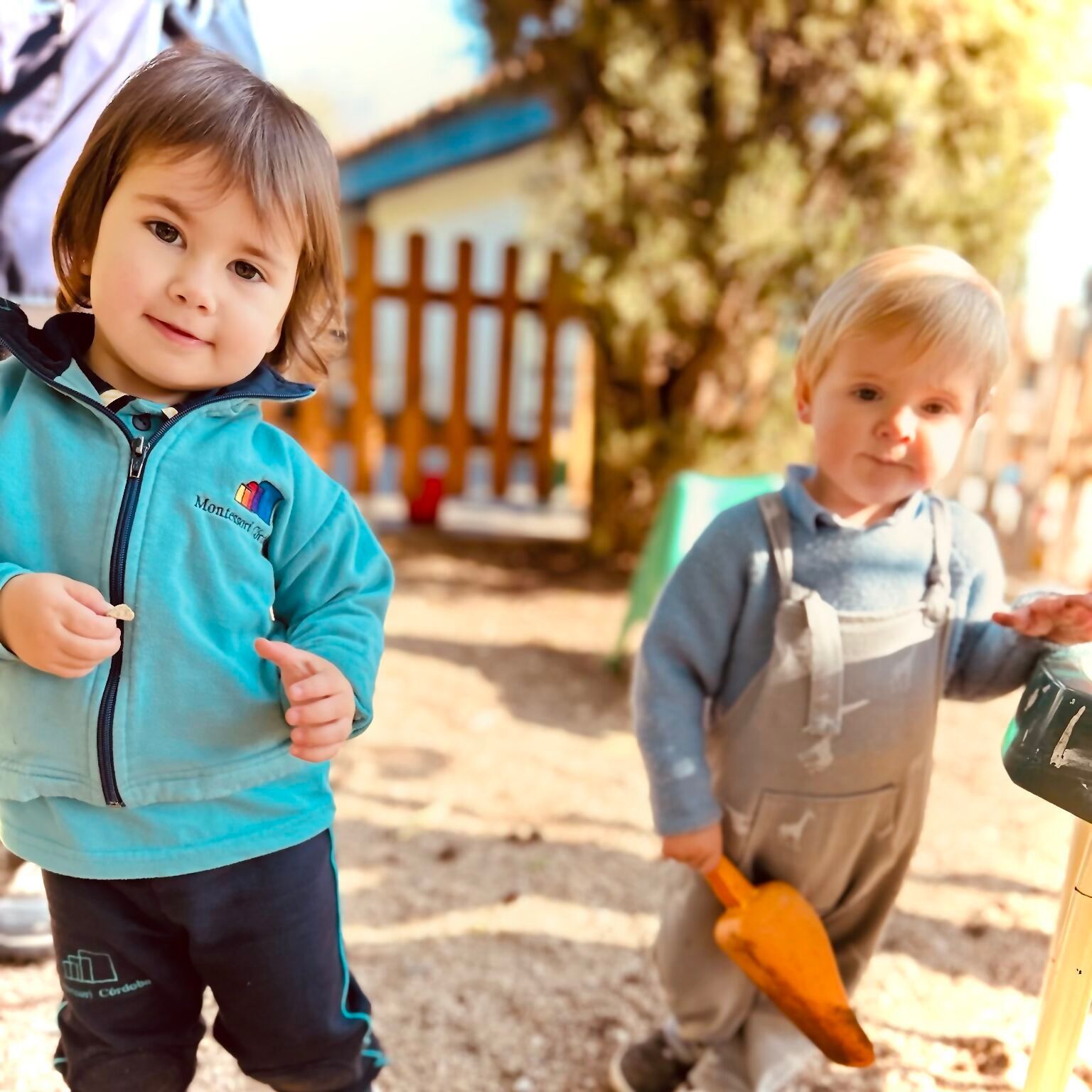
Children in this stage of development love to practice real, everyday activities such as dress frames that help them learn to button their coats or fasten their shoes. Child-sized utensils are provided, and they participate in simple hands-on activities such as cutting a banana or squeezing an orange, cleaning the table, sweeping the floor, and tending to the plants. These activities help children build their self-confidence, learn to act independently, practice concentration, and control their movements. They learn to exercise self-control, practice independence, and show respect towards themselves (personal care), others (social development), and their environment (care for the environment).
Children's innate curiosity about language is encouraged through the use of visual and auditory aids such as picture and word cards, stories, poems and songs. A trained adult who knows how to engage in conversation with children and actively listen to them is also key to helping them acquire a diverse and extensive vocabulary. The period between one and three years of age is a natural and instinctive time for children to acquire one or more languages. Providing a language-rich environment enhances children's vocabulary. At Montessori Córdoba, we offer an English-speaking environment, where we also know that work on musical and artistic expression, are considered crucial to communicative development at this stage.

The Children’s House

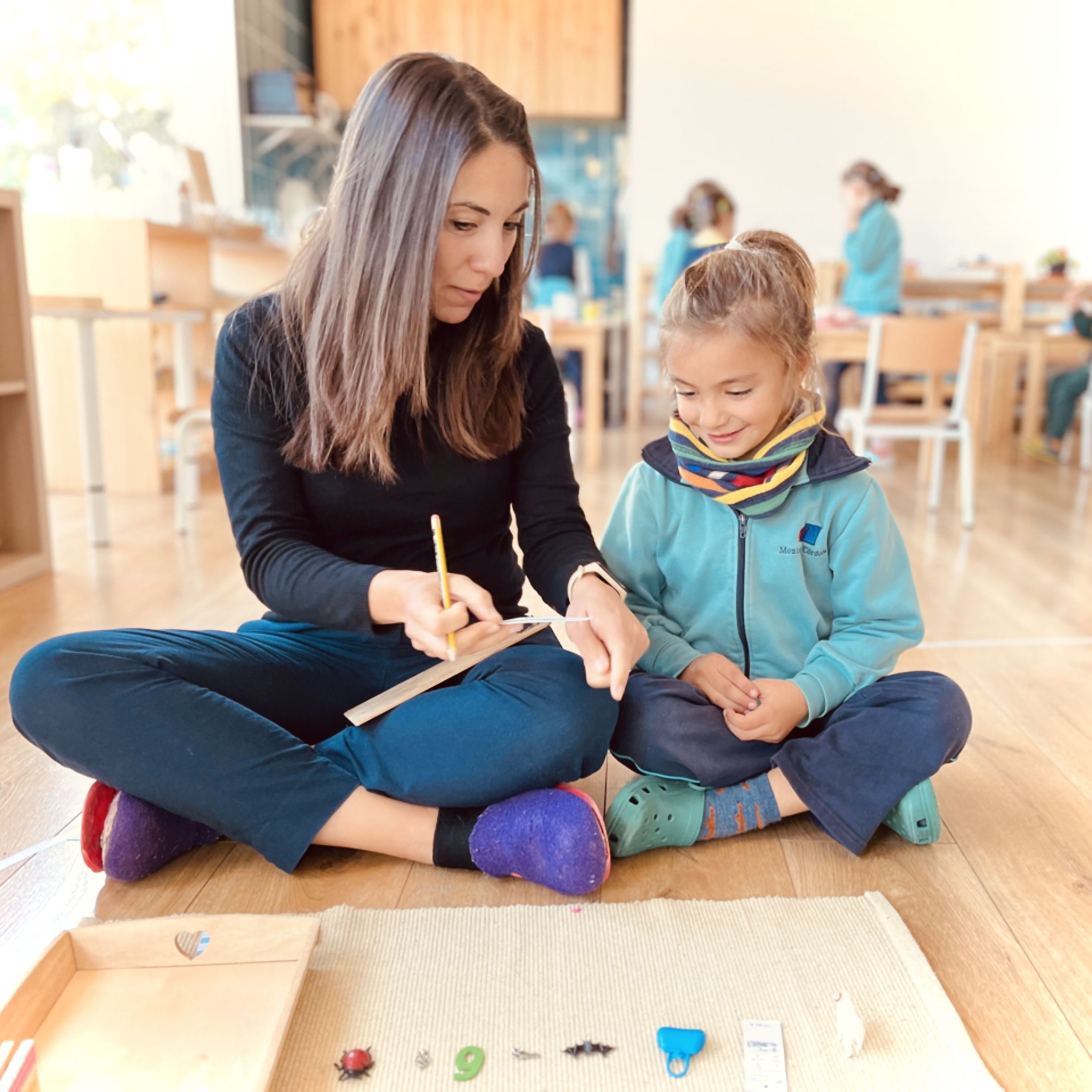
In Children’s House, the teachers observe each child’s progress in each area, introducing each concept precisely at the right time to capture the child’s interest and provide them with stimulating sequential activities so that they can successfully advance their learning.

Children have the opportunity to participate in a variety of self-directed learning activities, including areas of study such as Mathematics, Language and Culture. In this community, each child can learn at their own pace and explore a variety of materials specially designed to stimulate their development, curiosity and wonder about the world.

The classroom is designed to encourage independence and responsibility, with materials organized on low shelves and available in limited quantities. This encourages children to return items to their places and learn to share and collaborate on various everyday tasks. Each class enjoys an indoor classroom and direct access to its outdoor classroom, and they can choose to do activities inside or outside during any time of the day.

The learning activities are practical and sensory, designed to stimulate all of the children’s senses. Teachers, known as Montessori Guides, provide guidance and support as children explore and discover at their own pace. There are clear and consistent rules of coexistence that help children feel safe in an environment of routine and predictable order.

Observation is fundamental in the Montessori approach, allowing teachers to understand each child’s individual needs and adapt activities accordingly. This relationship between teacher and student promotes personalized learning and holistic development in a nurturing and stimulating environment.

In the Children’s House, there are a maximum of 13 children per adult.

The Children's House is a space where children can interact with a diverse community of different ages. This environment encourages collaborative learning and mutual respect. Children feel that the functional space belongs to them, and everything about it is designed to provide them with ease of access to the materials in order to enjoy their daily tasks with a sense of well-being. They take care of their environment and take great pleasure from being there.

In the Children's House, there is a three-year age range, which allows for the formation of a Mini Community. In this community, younger children learn by observing the older ones, while older children gain confidence by helping the younger ones with activities and reviewing the knowledge they have acquired. Mutual respect for oneself, others, and the surrounding environment is the basis of the community life.

Through these communities, children learn to interact with others of different ages and personalities. They also learn to treat each other with compassion and dignity, as every older child was once a younger one, and the cycle continues.
Children are born with natural abilities to investigate, classify, guide, order, reason, calculate and measure. Mathematical concepts are accessible and easy to understand when manipulating concrete Montessori materials that gain in complexity as children go through a sequence designed so that they experience the amazement of discovery at each step. Pre-mathematics sensory materials introduce children to mathematical concepts and the world of geometry in a playful and accessible way. These sensory experiences provide them with innate knowledge that will give them great confidence in their mathematical learning later on.

In our individualised learning environment, children fully understand each concept before moving on to the next, making Montessori children confident and enthusiastic mathematicians.

Children possess innate abilities to investigate, classify, guide, order, reason, calculate, and measure. These abilities can be developed easily and naturally through the use of Montessori materials that become more complex as children progress through a carefully designed sequence. By manipulating concrete materials, children experience the joy of discovery at each step, which makes mathematical concepts accessible and easy to understand. Pre-mathematics sensory materials introduce children to mathematical concepts and the world of geometry in a playful and engaging way. These sensory experiences provide children with innate knowledge that will give them great confidence in their mathematical learning later on.

In our individualised learning environment, children are encouraged to fully comprehend each concept before moving on to the next. This approach makes Montessori children confident and enthusiastic mathematicians.
A language-rich environment provides children ages 3 to 6 with the stimulus they need to develop their communication skills in English, the target language of our educational centre. The guides always communicate with the children in English, in a very direct, respectful way and using varied but precise language to give the children the repetition they need to acquire an ample vocabulary in English. There are many songs, rhymes and stories at this stage. The introduction to writing and reading begins with sensory materials and many varied and interesting presentations in which they explore and learn the sounds that make up our morphology. When they have internalised this, they start playing with the syntax of English, creating little books and making phrase games with their guide and later in groups.
The manipulation of sensory materials provides a strong foundation for developing observation, perception, order, and the capacity for reflection. These skills are highly valuable when children later work on academic subjects like mathematics, science, and languages. These materials refine students' senses so that they can observe the world with scientific and artistic appreciation. The knowledge they acquire through all their senses is experiential learning that remains imprinted on their psyche. Through the refinement of their senses, children learn to observe by experimenting and classifying subtle differences between tones, dimensions, textures, smells, sounds, and flavours, enabling them to appreciate the world around them in all its richness and splendour. Exploring variations and games with these materials gives children a sound base for developing executive function skills such as memory, reasoning, creative problem-solving, and critical thinking.
The first questions about the composition, organisation and functioning of the world begin to form at this stage.
  • They explore the globe, countries, land and water shapes, and play games sorting cards with fun objects and miniatures.
  • They learn to classify and name in the areas of botany and biology.
  • They explore music through songs, movement, and sensory materials.
  • They enjoy the freedom to create as they wish in the art area and learn how to care for materials and clean up after the activity with a wide selection of artistic media.
As in the Infant Community stage, the practical life area provides children with endless activities that have a real purpose and are very attractive to them because they are the daily activities that they see adults do. With these materials, they work on the perfection of movements, sequentiality, and concentration and learn to identify the feeling of satisfaction that comes from a job well done and finished.

Activities include washing and ironing rags, sewing, handling tools, and caring for your classroom. For breakfast and lunch, they set the table and prepare and serve food, pick up leftovers, and wash their plates. They start taking responsibility for taking care of plants and flowers and taking care of themselves and their belongings. The pace is calm, and they have the time to carry out these tasks with concentration and care.

These skills allow them to function with increasing independence in the adult world, and children feel a great sense of competence when they master new practical skills.

“Help me do it by myself” is the child's moto at this stage of development.
Education begins at home with the family. The family is the primary educator in a child's life; no one knows your child like you do. The family has a unique opportunity to share their values, hobbies, interests, and culture. You are the most significant influence on the development of your child's mind and character.

The Montessori school is a natural extension of the child's home, and we strongly encourage families to participate in school life.

Montessori teachers are called Montessori Guides. Both the guides and the assistants in the Children's House have received in-depth training. They are experts in child development, in observing children and their tendencies, and in preparing an environment that provides each child with what they need in the classroom—all in a warm, calm, safe, and happy environment.

The Guides monitor each child's progress and interest in each area to connect the child with the suitable activity at the right time. Then, the guide gives an individual, clear and inspiring presentation of the new material. The child already knows he can add this activity to his repertoire of many others; he can choose to work freely from everything the guide has ever presented to him.

If the guides observe a child making a mistake when using a material, instead of intervening or correcting it at the moment, the guide will offer the child another presentation later. Montessori guides ensure each child's success and are advocates of each child's natural and individual development in the most profound sense.

Elementary

Our elementary program builds on the educational foundation of the infant stage and greatly expands it. This is the age when children want to discover how things work in human society and the natural universe. The lessons that are given are designed to spark the imagination and inspire wonder and interest in each student. Children begin elementary school working with concrete materials to introduce new concepts. As children progress through the stage, they are introduced to abstract working concepts.

Our elementary program supports not only academic but also social and emotional development. Our goal is to develop culturally literate children who develop a deep respect towards themselves, others, society and the natural world. At Montessori Córdoba we prioritise and nurture their innate curiosity, creativity, and intelligence.

Each class enjoys an indoor classroom and direct access to its outdoor classroom, and children can choose to do activities inside or outside during their work times.

In the Elementary environment, there are a maximum of 13 children per adult.

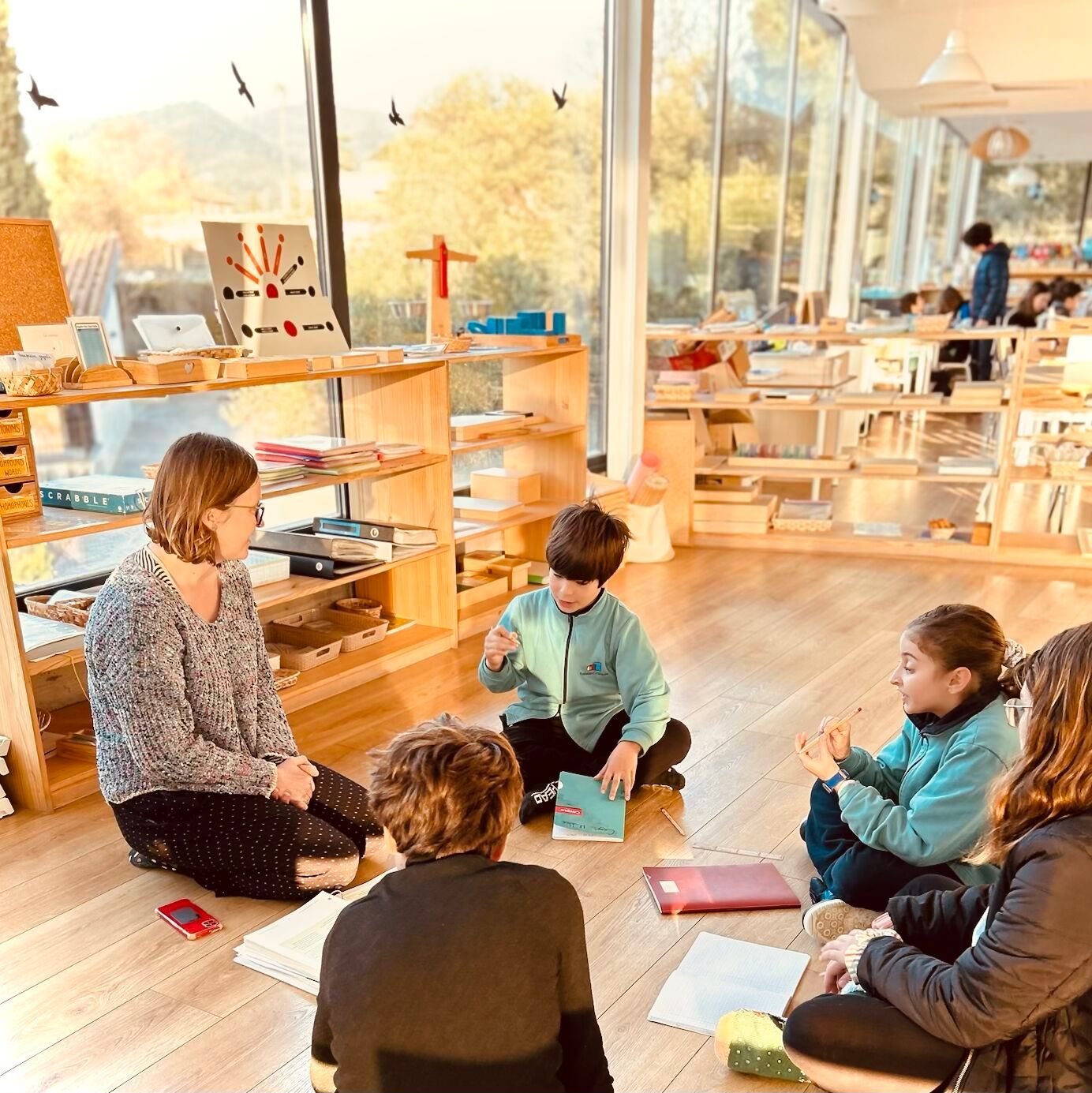
Between the ages of 6-12 years, children learn about life in community and society. They are very interested in group dynamics, justice and belonging. To accompany them in this sensitive moment, it is important to provide them with infinite social experiences and help them understand the etiquette, roles, responsibilities and demands of community and group work (and play). This social and emotional development work is part of our Education for Peace work. Children aged 6-12 should develop and talk about their work with their peers since this is how they learn best at this stage. For this reason, your school day may now have moments of individual concentration but will have many moments of applied activity in small work groups. Peace work emphasises the development of universal human values. Our program helps children build a positive personal narrative in which they belong, have a purpose, and know how to defend and identify their values and their role in society and their community.  
  • Social and emotional or peace work begins with presentations and role-playing in daily class assemblies to learn how to manage emotions, needs, and boundaries—both your own and those of others. We teach techniques and work related to coexistence, such as creating a class constitution, using peace tables, and holding peace conferences designed to guide children in conflict resolution.
  • The comprehensive vision of the universe that Montessori education provides children with is the base, or the broad vision, that everything in the universe is connected, presenting less the idea of “the other” and more the idea of “ours.” The historical focus in this socially sensitive stage of development is on the great achievements of nature and human beings, leaving the focus on war and conquest for later stages in their development.
  • Democratic education. The children know that their opinions and ideas count and are respected at Montessori Córdoba. The team of adults supports and advises the community, but the children know that their school, class, and educational community belong to them and their peer group and that their ideas and opinions are listened to and considered. The development of responsibility towards their environment with acts as simple as cleaning, repairing, and ordering their capacity to affect change through community meetings and meetings between class delegates and school leadership are experiences which impact the development of civic responsibility and the growing child’s confidence in their own power to improve things.
  • The educational program's design and the mixed-age communities help the children develop their intrinsic motivation and understand that they are not in competition with each other to see who is better. Instead, they work with each other on the path to self-improvement and the improvement of their community.
  • Our educational program and mixed-age classrooms help children grow free of negative comparisons and recognise that everyone is a unique being who deserves to be respected and valued; each is different from others but belongs to the group. The international atmosphere helps children to develop a more objective sense of their own culture and language and to have a broad outlook and confidence in multilingual or cultural contexts.
Children at the Elementary stage are fascinated with the idea of discovering how things work. They want to get closer to answers about how the universe and living systems work. Why? and how? are the most frequently asked questions. We take advantage of this interest by providing children with all the information, materials, experiences, activities, and lessons available in our three Elementary classrooms at Montessori Cordoba. Science is a very popular learning area for children aged 6-12 at our school. The integrated curriculum and the Five Great Lessons illustrate the connection between the natural world and humans to satisfy children’s growing interest in understanding the functioning of the universe and their place in it. The Five Great Lessons are interactive stories that spark children’s curiosity to investigate more aspects of natural and human development. They listen to each great lesson up to 6 times during their Elementary years, but the follow-up work will be different each year, according to each child’s development and interest:
  • The First Great Lesson: The Beginning of the Universe and the Earth
  • The Universe
  • The Solar System
  • The Composition of the Earth
  • Volcanoes
  • Rocks
  • Chemistry: the three states of matter
  • Creation stories
  • The Second Great Lesson: The History of Life on Earth
  • Bacteria
  • Plants
  • Fossils
  • Dinosaurs
  • Living and non-living beings
  • Classification
  • Animal Kingdom (Classification and parts of: insects, fish, amphibians, reptiles, birds, mammals)
  • Oceans
  • Glaciations
  • The Third Great Lesson: The History of Humanity
  • Ancient civilisations
  • The fundamental needs of human beings
  • The story of:
    • Tools
    • Food cultivation, preparation and storage
    • Clothes
    • Shelter
    • Transport
    • Medicine
    • Defense
    • Art
    • Religion/Spirituality
  • The Fourth Great Lesson: The History of Communication and Writing
  • The history of writing
  • Hieroglyphic and cuneiform writing
  • Different alphabets
  • Different writing systems (letters and characters)
  • Ancient civilizations
  • The printing press
  • The Fifth Great Lesson: The History of Numbers
  • The history of numbers
  • The history of mathematics
  • Different number systems
  • The story of "zero"
  • The invention of the calendar
  • Measurement systems and units
The elementary subjects are separated into the main or core subjects, each with a very broad sequence and scope in which students receive presentations each week and the complementary subjects.

Get to know our main subjects
In the Elementary stage, the teachers give presentations (lessons directed at small groups or individuals based on their educational needs). These groups are dynamic and can be composed of different ages, abilities, or interests. Children learn which presentations they will attend at the beginning of each day. Elementary presentations are short, dynamic and as captivating as possible, leaving the child with a desire to investigate further. When a child is not receiving a presentation, they may be:
  • Working on their follow-up work from any area.
  • Working on a project individually or in a group
  • Taking a break
  • Processing their learning with a handwork activity
  • Filling out their work journals and thinking about their individual goals
  • Choosing or planning their next activity
  • Carrying out their responsibilities (caring for the environment/plants/helping other children)
  • Organising group work with their classmates
In some areas, such as calculus, geometry, or grammar, follow-up work involves repetition, exploration, and application. In science or cultural areas, the teacher will normally offer two follow-up work options; both options will require the same effort, applied in different ways to be attractive to students with different learning profiles. Teachers also accept and consider proposals for other types of follow-up work if they involve effort and in-depth study of the material. The use of worksheets is limited because children usually consider their work done when the worksheet is finished. However, we use writing frames to guide children in developing different writing skills.  Follow-up options are usually open-ended so that children can elaborate on their investigations as much as they want. The end product is a demonstration of their learning. The habit of exerting maximum effort and being creative leads to increasingly diverse work as children pass through our Elementary programme. They are inspired by older peers who share more creative proposals, such as showing learning through plays, digital presentations or creating expanded written works.
When children choose their area of research based on a personal interest, they are committed to their activity, are inspired and are engaging in meaningful work. The teachers guide the children to motivate them and ensure that they balance personal interests with work from our full core curriculum to ensure children acquire the educational foundations for their personal and academic future.

Projects with great personal meaning are ideal for practising project management skills such as teamwork, the distribution of roles and responsibilities, and the consequences of errors in planning or execution. Children learn that their decisions, actions and efforts impact the group's project results. The teachers oversee these projects, looking for opportunities to incorporate meaningful learning opportunities, which can range from applied maths and grammar, writing and communicating with different audiences, the expressive arts to share knowledge, the organisation of resources and materials for the execution of a project, and the subsequent reflection on the difficulties encountered and how we can better plan to avoid these errors in the future.

Our programming is very broad and covers all aspects of each person's development, however, we prioritise:
  • English literacy skills
  • Spanish literacy skills
  • Effective bilingual communication
  • Mathematical reasoning skills
  • Critical thinking skills
  • A growth mindset
  • Scientific rigour
  • Creative thinking and confidence
  • Developing strong study habits: concentration, responsibility and organisation
  • A strong self-esteem and self-awareness
  • Learning and applying interpersonal and intrapersonal skills
  • Intrinsic motivation in work
The work plan is key in developing self-directed learning skills and preparing children for the independence required in higher education and adult life. In the first years of the Elementary programme, this work plan will be a visual tool to guide children in ensuring their learning encompasses all curriculum areas. Towards the end of the Elementary stage, it takes the form of a work journal, a base for planning, accountability, and setting personal targets.

The work plan helps children acquire a good work rhythm and habits and supports them and their teachers in reflecting on their tendencies and progress as learners. Giving children ownership of their learning is a powerful motivator and an essential life skill.

Between the two work cycles, there is a quick informal reflection on work progress each day. Once every one or two weeks, in the individual work planning conference, the teacher and child meet to evaluate their work in progress and decide at what pace and in what direction the child’s learning will proceed over the next week.
The daily assembly is usually at the end of the first work cycle. In the community group, the entire class meets to talk together. They reflect on the morning and plan for the second cycle, talk about events or incidents in the group, or take part in activities related to their social and emotional development. They children share things from their lives outside of school and ideas for events or projects. The assembly is a moment of communion and an important time for strengthening community life.
Developing independence is key to a student's success at our school. Freedom is necessary to develop independence, but too much freedom without the corresponding responsibility can leave children feeling insecure and create a chaotic environment where concentration is challenging. On the contrary, too many limitations stifle the development of a child's intelligence, creativity, and confidence.

Our teachers are highly trained to support this careful balance; children at Montessori Córdoba understand that responsible and respectful behaviour warrants more freedom to choose and act independently. The opportunity to observe older classmates exercise increasing freedom and responsibility is a powerful guide for children as they grow.

Many aspects of our methodology contribute to the development of strong executive functions. The unique characteristics of our education programme gradually equip our students with the capacity to analyze the short—and long-term impact and consequences of their actions.

This capacity to choose wisely is applied to many scenarios, for example, the decision to concentrate on your work instead of socialising, the decision to complete your least favourite tasks first thing in the morning, or the decision to complete your part of a project with maximum effort for the benefit of your workgroup. Children learn: If I choose well, I will see success. Children do not learn this quickly; developing strong executive functions requires years of trial and error. When achieved, children understand that the concept of freedom carries a factor of responsibility and grow to become adults who can live and contribute responsibly and successfully within society.
The adults at Montessori Córdoba accompany the children in their emotional and social development as well as their academic learning. The first step is to be a model of self-regulation. Interactions with and between adults within the school are always respectful and patient; we do not raise our voices unless it is to warn of danger. Respect towards each other as individual beings is evident in our day-to-day interactions and the structures of learning and school organisation. We recognise error as an inseparable part of healthy growth and learning. The absence of punishments, humiliation, and public comparisons gives all members of the community the freedom to be authentically themselves, share their strengths with others, and recognise their own areas of growth.

Adults in the school carefully prepare the social, emotional, cultural, and physical environment for children’s learning. At Montessori Córdoba, we work to prepare children for life, recognizing that learning is a lifelong journey and that our students will make mistakes on the way.

Children enjoy our unwavering support when difficulties arise and our belief in their capacity for growth, learning and self-improvement. When the adults surrounding a child believe in their capacity, they learn to believe in themselves.

Our team is made up of highly qualified education professionals who share our mission. We choose the best and most motivated teachers to work at Montessori Córdoba. Each one has a real vocation to accompany the children in their class to the best of their ability.

Each classroom has a minimum of one teacher for every 12 or 13 children. The first teacher is the Lead Guide and is responsible for the education and progress of the students. In groups of more than 12/13 children, the second teacher is the Support Teacher (often called an Assistant). While the Lead Guide makes individual or group presentations, the support teacher circulates around the classroom, supporting, accompanying, or giving small lessons to support the children's work.

The main teacher always communicates in English with the children, and the support teacher communicates in English, except during Spanish language, history, and geography lessons.

You can see more details about our team.
Whole-class field trips are one aspect of the elementary program, but going out is different. When children Go Out into the local community, they are participating in authentic learning experiences outside the classroom:
  • They decide what type of excursion will cover the purpose of their investigations
  • They look for the necessary information
  • They choose the place they will go
  • They investigate how to get there
  • They calculate the costs
  • They establish the time they will need
  • They plan what they should take with them
  • They invite classmates and adult chaperones
There are many presentations to prepare children for Going Out: how to search for information online, how to use public transportation, how to do interviews, how to make consultation calls, etc. It is normal that during the first years of Taller, going out is simple, like going to buy something for a project, and little by little, it becomes more complex over the years until it includes train trips and overnight stays.

The role of adults when Going Out is to ensure the safety of children. Children are responsible for all aspects of the trip.
The evaluation of our students is continuous. Class guides constantly observe the children and their work to create very detailed records (on Transparent Classroom, our recording and evaluation platform). The work that children do, the presentations they receive and how they advance in the level of Mastery of each area of knowledge or skill that has been presented to them are recorded. We also evaluate children’s progress toward mastering the development of other areas, such as interpersonal or social skills and executive functioning skills. Families receive a very detailed report each semester on each aspect of their child's progress and development and have ample opportunity in the quarterly tutorials or at other times to comment on their contributions, doubts, concerns, perspectives or questions to their child's teachers.
The evaluation of our students is continuous. Class guides constantly observe the children and their work to create very detailed records (on Transparent Classroom, our recording and evaluation platform). The work that children do, the presentations they receive and how they advance in the level of mastery of each area of knowledge or skill that has been presented to them are recorded. We also evaluate children’s progress toward mastering the development of other areas, such as interpersonal or social skills and executive functioning skills. Families receive a very detailed report each semester on each aspect of their child's progress and development and have ample opportunity in the quarterly tutorials or at other times to comment on their contributions, doubts, concerns, perspectives or questions to their child's teachers.

We are here to answer all your questions

Lucy Welsted and The Education for Life Group are partners of the Erasmus-funded Bilingual Montessori Project: bilingualmontessori.com